How to Choose a PVC Hose Supplier from China: A Practical Guide for Ecuador Importers
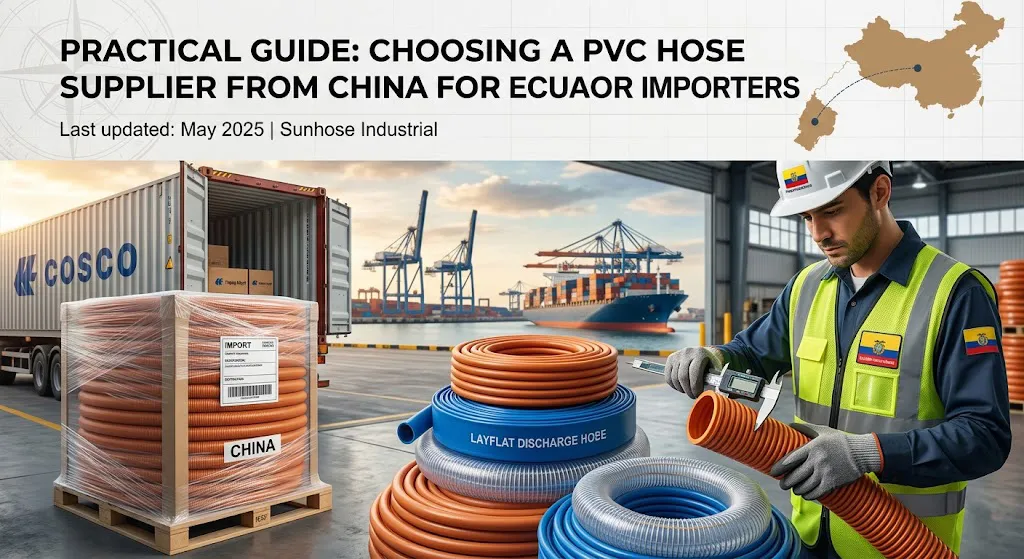
Choosing the right PVC hose manufacturer in China is one of the most consequential procurement decisions for Ecuadorian importers and distributors. The wrong supplier means substandard wall thickness, delayed FOB shipments, and costly replacements that erode your margins. The right supplier means consistent quality, on-time delivery, and a long-term partnership that scales with Ecuador's growing agriculture, construction, and aquaculture sectors.
This guide gives importadores ecuatorianos a step-by-step framework for evaluating Chinese PVC hose manufacturers — covering factory verification, product certifications, MOQ requirements, shipping terms, and the red flags that experienced buyers know to watch for.
Why Ecuador Importers Source Hoses from China
Ecuador imports approximately 3,500 metric tons of plastic hose and hose fittings per year, with China consistently ranked among the top two source countries. The reasons are structural:
- Price competitiveness: Chinese PVC hose factories benefit from integrated raw material supply chains (PVC resin, polyester yarn, steel wire) that are difficult to replicate locally or in Latin America.
- Product breadth: A single Chinese supplier can provide layflat discharge hoses (for banana plantation irrigation and shrimp farm water management), steel wire suction hoses, rubber air hoses, and camlock couplings — reducing the number of vendor relationships you need to manage.
- OEM capability: Factories in Qingdao, Weifang, and Hebei offer private-label printing, custom colors, and specification customization that regional distributors in Guayaquil and Quito cannot match.
Ecuador's core hose demand is driven by three sectors: agricultural irrigation (banana, rose, broccoli, palm oil), aquaculture (shrimp farm water intake and discharge), and construction and mining (dewatering, concrete pumping). Each sector has different pressure ratings, diameter requirements, and chemical resistance needs — which means your supplier selection criteria must start with your application, not the price list.
Step 1: Define Your Technical Requirements Before Contacting Any Supplier
Vague inquiries attract vague quotes — and waste everyone's time. Before reaching out to any Chinese manufacturer, document the following:
| Specification | Common values for Ecuador market |
|---|---|
| Hose type | PVC layflat, PVC steel wire suction, rubber discharge |
| Inner diameter (ID) | 2" to 8" for agriculture; 1" to 4" for construction |
| Working pressure | 4–10 bar for irrigation; 6–16 bar for suction hose |
| Temperature range | -5°C to +60°C for most PVC; wider range for rubber |
| Annual volume | Expressed in meters (e.g., 10,000 m/year) |
| Roll length | Standard 50 m or 100 m rolls; custom available |
| Color | Blue or orange for layflat; black/grey for suction |
| Certifications required | CE, RoHS, SGS test report |
Why this matters for Ecuador specifically: the Servicio Nacional de Aduana del Ecuador (SENAE) classifies industrial hoses under HS code 3917.39 (other flexible tubes and pipes, of plastics). Import duties are applied on CIF value. If your specifications are not clearly documented in the purchase order and commercial invoice, customs can reclassify the product and apply a different duty rate, creating clearance delays at the Port of Guayaquil.
Step 2: Evaluate These Five Quality Indicators
Not all PVC hoses are equal. Two hoses with identical outer dimensions can differ significantly in wall thickness, PVC compound quality, and yarn reinforcement strength. Here is what to inspect before placing a bulk order:
1. Wall thickness vs. stated specifications
Cut a cross-section of the sample hose and measure actual wall thickness with a caliper. Some factories reduce wall thickness by 10–15% while maintaining the same outer diameter — a savings that comes at the cost of burst pressure resistance and service life.
2. PVC compound quality
Premium PVC hose uses 100% virgin PVC resin (not recycled). Ask for the material certificate and specify "no recycled PVC" in your purchase order. Recycled-compound hoses become brittle faster in Ecuador's climate, especially in coastal banana and shrimp farm environments with high UV exposure and temperature fluctuations.
3. Yarn reinforcement
For layflat discharge hoses, the polyester yarn reinforcement should be circularly woven (not spiraled) for even pressure distribution. Pull the sample hose to assess whether the yarn separates from the PVC layers — delamination under field conditions is a common failure mode with low-quality products.
4. Pressure test results
Request a factory pressure test certificate showing burst pressure at a minimum of 3× working pressure. For a 6-bar working pressure hose, the burst should be confirmed at 18 bar or above. For suction applications, also verify that the PVC suction hose maintains its circular cross-section under the rated vacuum without collapsing.
5. UV resistance
For outdoor agriculture applications in Ecuador's Pacific Coast regions, ask whether the outer cover compound includes UV stabilizers. This is especially important for layflat hoses used in open-field irrigation that are exposed to sun for 6–10 hours per day.
Step 3: Understand MOQ, Lead Time, and Shipping Terms
Minimum Order Quantities (MOQ)
Standard MOQs from Chinese PVC hose factories range as follows:
| Product | Typical MOQ |
|---|---|
| PVC layflat discharge hose | 1,000 m – 3,000 m per size |
| PVC steel wire suction hose | 500 m – 1,000 m per size |
| Rubber water/air hose | 500 m – 2,000 m |
| Camlock couplings | 100 pcs per size |
For new buyers evaluating quality before committing to bulk orders, reputable factories will provide sample lengths of 1–2 meters (freight cost typically on buyer's account). Always request samples before placing any order above $5,000.
Lead Time
- Standard products (in-stock colors and sizes): 15–25 days after order confirmation and deposit
- Custom specifications (non-standard ID, special colors, logo printing): 25–35 days
- Peak season delays: Chinese factories typically have reduced capacity during the Spring Festival (January–February) and around the Canton Fair (April and October) — plan your orders accordingly
Shipping Terms: What Works Best for Ecuador Importers
The most common Incoterms used for Ecuador hose imports from China:
FOB Qingdao / Tianjin / Shanghai — You arrange the freight and insurance from the Chinese port. This gives you control over logistics costs and allows you to consolidate shipments from multiple suppliers. Best for experienced importers with established freight forwarder relationships in Ecuador.
CIF Guayaquil — The Chinese supplier arranges freight and insurance to Guayaquil. Simpler for smaller buyers, but you pay a margin on the supplier's freight arrangement. Verify the quoted freight against market rates — some suppliers inflate freight costs by 15–30%.
Recommendation for Ecuador importers: Unless you have strong logistics capacity, CIF Guayaquil is the most practical starting point. As your order volume grows, transitioning to FOB gives you better total cost control.
Step 4: Avoid These Five Common Mistakes
Ecuadorian buyers who have sourced from China report these recurring problems:
1. Buying on price alone A quote 20% below market is a signal, not a bargain. The savings are almost always in wall thickness, compound quality, or yarn count — and you will pay for it in product failures and customer returns within 6–12 months.
2. Not specifying recycled-PVC exclusion in the purchase order Without this clause, the factory can substitute recycled compound, especially after your first few orders establish trust. Make it a standing specification, not a verbal agreement.
3. Ignoring port congestion seasonality Chinese ports — particularly Qingdao and Tianjin — experience congestion during Q4 (October–December) as factories rush pre-Lunar New Year shipments. Orders placed in September or October may not arrive in Guayaquil until January or February. Plan your inventory accordingly.
4. Skipping factory verification for low-value orders Even for orders under $10,000, factory verification matters. A single batch of substandard layflat hose that fails during Ecuador's banana harvest or shrimp farm operations will cost far more in customer damage claims and relationship repair than the savings from skipping due diligence.
5. Mismatched certifications for end-use applications If your end customers require CE-marked products or specific material safety declarations (especially for food-adjacent applications like potable water supply), confirm these certifications with the factory in writing before order placement — not during shipment preparation.
What to Expect from a Qualified Chinese PVC Hose Supplier
A reliable manufacturer — not just a trader — will provide the following as standard:
- SGS or Rosh test reports for each product line, updated within the past 24 months
- ISO 9001:2015 quality management certification
- Material safety data sheets (MSDS) for PVC compound
- Production photos and pre-shipment inspection (or third-party inspection access)
- Clear written warranty policy (typically: replacement for manufacturing defects within one year)
- Dedicated account manager who responds within 24 hours during Chinese business hours (UTC+8)
Key Questions to Ask Before Placing Your First Order
Use this checklist when evaluating any Chinese PVC hose supplier:
- Can you provide a factory business license showing manufacturing scope?
- Do you use 100% virgin PVC resin? Can you provide a material certificate?
- What is your actual production capacity per month for this product?
- Can you provide SGS pressure test reports for this specific hose?
- What is your lead time for standard products currently in stock?
- What Incoterms do you offer, and can you quote both FOB and CIF Guayaquil?
- Do you offer OEM labeling and custom roll lengths?
About Sunhose Industrial
Sunhose Industrial Company Limited is a manufacturer and exporter of PVC hoses, rubber hoses, hydraulic hoses, layflat hoses, hose clamps, and camlock couplings with 25+ years of B2B export experience. Our products are SGS-tested and comply with RoHS and REACH standards. We manufacture over 35 hose product types and support FOB, CIF, and CNF shipping terms.
We have supplied distributors and industrial buyers across Latin America, including Ecuador, with consistent quality and on-time delivery. Standard MOQ is 1,000 meters per product. Sample orders are available.
Contact us: Email: [email protected] | WhatsApp: +86 180 5604 4070 | Request a Quote →
Related Articles
- Irrigation Hose Import Guide for South Asia — Bangladesh, Pakistan, Sri Lanka
- How to Choose a PVC Hose Supplier from China: Middle East Buyer Guide
- PVC Layflat Discharge Hose for Agriculture in Africa: A Complete Buyer's Guide
- What to Pay Attention to When Sourcing Lay Flat Hose
- PVC Layflat Hose — Product Page
- PVC Steel Wire Suction Hose — Product Page
Frequently Asked Questions
What is the typical import duty for PVC hoses into Ecuador? PVC flexible hoses (HS 3917.39) are subject to Ecuador's MFN (most-favored nation) tariff rate, typically in the range of 5–10% ad valorem on CIF value, plus 12% IVA (VAT). Actual rates vary by specific product classification — consult SENAE or your customs broker for the current applicable rate on your specific product code.
What is the minimum order quantity for PVC layflat hose from China? Most reputable factories have a standard MOQ of 1,000 meters per diameter and color combination. For mixed-container orders across multiple sizes, some manufacturers will accommodate lower per-size MOQs when the container is fully utilized. Sample lengths of 10–50 meters are generally available before bulk orders.
How long does sea freight from Qingdao to Guayaquil take? Transit time is typically 28–35 days for direct or transshipment services via major shipping lines (COSCO, Evergreen, Hapag-Lloyd). Add 3–5 days for port clearance in Guayaquil. Plan for a total procurement cycle of 60–70 days from order placement to warehouse receipt.
Can Chinese hose factories print our brand name on the hose? Yes. Most factories with extrusion lines can print custom text (brand name, pressure rating, diameter, CE mark) on the hose cover at no additional tooling cost for standard font sizes. Minimum printing order quantities typically apply — confirm with your supplier.
What quality certifications should I require for hoses used in agricultural irrigation in Ecuador? At minimum, require: (1) SGS hydraulic pressure test report confirming working and burst pressure; (2) material composition certificate confirming RoHS compliance and absence of restricted substances; (3) UV resistance test results if the hose will be used in open-field outdoor applications.
Is it possible to visit the factory in China before ordering? Yes, and for orders above $1,000,000 annually it is strongly recommended. Most Chinese manufacturers in Qingdao and Weifang can arrange factory visits with advance notice.